DIY vs. Professional Excavation: When Each Makes Sense
DIY excavation with a rented mini-excavator costs $350–$600 per day. Professional contractors charge $10–$50+ per cubic yard. Here is how to decide which is right for your project.
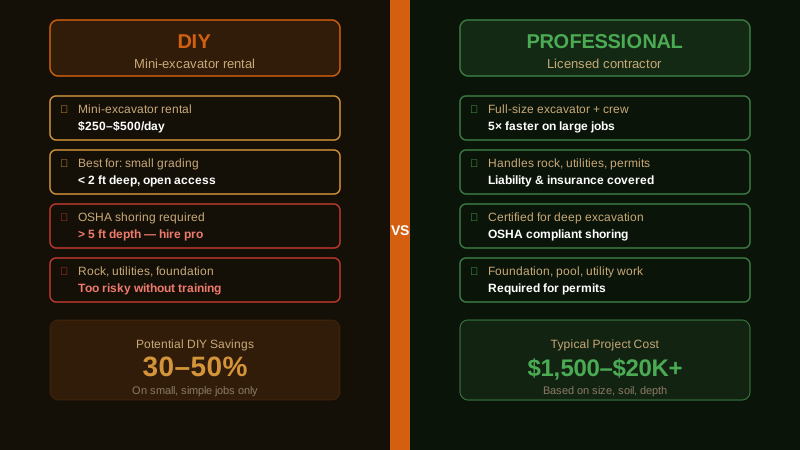
DIY excavation with a rented mini-excavator can save 30–60% on small projects. But for anything deeper than 4 feet, near utilities, in rocky soil, or requiring a tight timeline, hiring a professional contractor is usually the smarter financial decision once you factor in risk and realistic time costs. Here's how to think through the choice honestly.
When DIY Excavation Makes Sense
The conditions where DIY excavation pencils out:
DIY Cost Example
Scenario: 20×15 ft utility trench, 3 ft deep, sandy soil
Volume: (20 × 15 × 3) ÷ 27 = 33.3 cubic yards
Professional contractor estimate (using our excavation cost calculator):
Sand/gravel at $12.50/cu yd × 1.10 (trench) = $458 excavation
Hauling at $12/cu yd = $400
Total professional estimate: ~$858
DIY cost:
DIY total: $900–$1,250
In this example, DIY costs more than hiring a professional. Why? The professional's production rate is far higher than a first-time operator with a rental machine. A contractor running a full-size excavator in loose sandy soil might finish this trench in 1–2 hours. DIY with a mini-excavator might take 6–8 hours.
DIY makes more sense when:
When to Hire a Professional
Hire a professional contractor when any of these apply:
Depth exceeds 5 feet
OSHA regulations require protective systems (shoring, trench boxes, or sloped walls) for excavations deeper than 5 feet with vertical walls. These systems require proper installation and inspection. An unpermitted DIY excavation that collapses can result in fines, liability, and most seriously, serious injury. Don't DIY deep trenches or basements.
Rock is present or suspected
A mini-excavator rental is not equipped for rock excavation. If you hit rock, you're either calling a contractor anyway or returning the machine with work unfinished. Contractors have breakers and the experience to assess rock efficiently.
Active utilities are present
Any excavation near buried utilities requires caution that professionals are trained for. Hitting a gas line or live electrical line is dangerous and expensive. Call 811 (free in the US), but also consider private utility locating ($300–$600) if you're in an older neighborhood where municipal marking may be incomplete.
Tight site access
If equipment has to be moved through a narrow gate, around established landscaping, or into a confined space, the wrong machine makes it worse. Professionals know which equipment fits and how to maneuver in tight spots without causing damage.
Weather or construction deadlines
A contractor can often mobilize within a week and complete residential excavation in 1–3 days. DIY on weekends might take several weeks, exposing an open excavation to weather, flooding, and liability for extended periods.
Foundation or structural excavation
Foundation excavation tolerances are tight. Over-digging damages bearing soil. Under-digging requires expensive blasting or chipping. Contractors doing foundation work typically guarantee their dimensions and carry liability insurance for damage to adjacent structures.
Equipment Options for DIY
If you decide to DIY, here's the equipment landscape:
Mini-excavator (most common rental)
Rental cost: $350–$550 per day, $1,000–$1,800 per week
Bucket capacity: 0.05–0.15 cubic yards (compared to 0.5–1.0 for a full-size machine)
Best for: Trenches, small pool excavations, tight-access sites, projects under 50 cubic yards
Limitations: Significantly slower than a full-size machine; cannot handle rock without a breaker attachment; soil may need to be hauled away in smaller loads
Full-size excavator
Rental cost: $800–$1,500 per day (rare for residential DIY; requires more expertise and transport)
Best for: Larger residential projects; much faster production rate
Note: Most rental companies require demonstrated operator experience and adequate insurance before renting full-size equipment. This is essentially professional territory.
Compact track loader (skid-steer)
Rental cost: $350–$500 per day
Best for: Grading, moving material after excavation, backfilling; NOT ideal for digging in cohesive soil or creating clean excavation profiles
Hand tools
For very small jobs (under 2 cubic yards), a pickaxe, spade, and mattock may be the most economical approach, especially in soft soil. For reference, 2 cubic yards is roughly a 6×6 ft area at 1.5 ft deep, which one person can complete in a full day of hard work.
The Insurance and Liability Question
Professionals carry liability insurance that covers damage to underground utilities, adjacent structures, and on-site injuries. If you're doing DIY excavation and you damage a water main, sewer line, or neighbor's underground irrigation, you're personally liable. The $500–$1,000 you might save on a small project can evaporate instantly if something goes wrong.
Get your utilities marked (call 811). Check your homeowner's insurance to see if DIY excavation is covered. Consider whether the savings justify the liability exposure.
The Bottom Line
For projects under 50 cubic yards, in soft soil, at shallow depth, with spoil that can stay on-site: DIY with a mini-excavator is worth evaluating. Run the numbers honestly, include rental, delivery, disposal, and a realistic assessment of how long the job will actually take.
For foundation work, deep trenches, rocky soil, or anything with real construction deadlines: hire a professional contractor. The per-yard cost is worth the speed, expertise, and liability coverage you're buying.
Before you commit either way, run the project through our calculator and compare that figure honestly against what DIY would actually cost you once rental, fuel, disposal, and your own time are in the column. If the gap is under $2,000 and the job is simple, DIY probably wins. If it's over $2,000 and anything about the site is tricky, a pro is almost certainly the cheaper answer.
Related Articles
How Much Does Excavation Cost in 2026?
Excavation costs range from $1,500 to $15,000+ for residential projects. This breakdown explains what drives the price and how to budget accurately.
Read articleconstructionExcavation vs. Grading: Key Differences and When You Need Each
Excavation removes soil from a specific area; grading reshapes the ground surface. Both move dirt, but the equipment, cost, and purpose are different. Here is how to tell which you need.
Read articleconstruction10 Ways to Reduce Excavation Costs Without Cutting Corners
Smart planning can cut excavation costs by 20–40% without compromising safety or quality. Here are 10 practical strategies contractors and homeowners use to keep earthwork budgets in check.
Read article