Foundation Excavation Cost: Budget Guide for 2026
Foundation excavation costs $3,500–$12,000 for most homes. This guide breaks down what drives the price for basements, crawl spaces, and slab foundations.
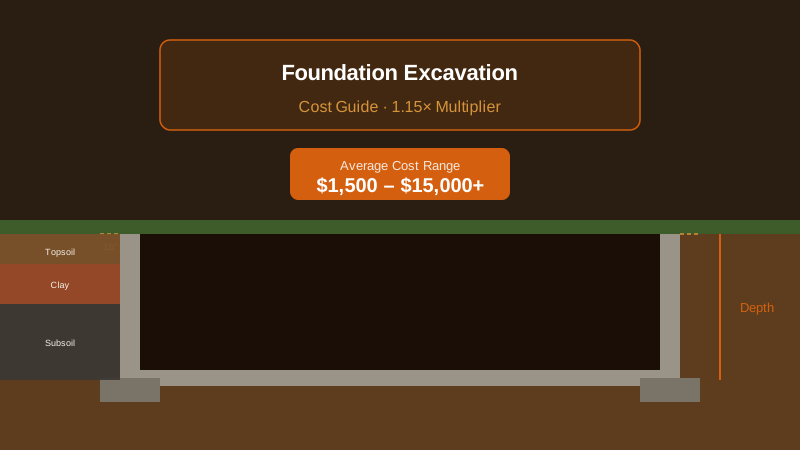
Foundation excavation cost for a typical residential home runs $3,500–$12,000, depending on the foundation type, soil conditions, and whether you're digging a full basement or just a shallow footing trench. Getting this number right early matters. It's one of the largest variable costs in a new home build or addition project.
Foundation Type Determines Your Depth (and Cost)
The three main residential foundation types have very different excavation requirements:
Full Basement
A full basement typically requires excavating 8–10 feet below finish grade. For a 1,400 sq ft home footprint (40×35 ft), that's:
(40 × 35 × 9) ÷ 27 = 466.7 cubic yards
At $15/cu yd for clay soil, with the 1.15× foundation multiplier and standard hauling at $12/cu yd:
Excavation: 466.7 × $15 × 1.15 = $8,051
Hauling: 466.7 × $12 = $5,600
Total: approximately $13,651
Full basement excavation for a medium-size home commonly runs $8,000–$18,000 depending on soil type and regional labor costs.
Crawl Space
Crawl space foundations require 3–4 feet of depth, enough for access and moisture management, but far less digging than a basement. On the same 40×35 ft footprint at 3.5 ft depth:
(40 × 35 × 3.5) ÷ 27 = 181.5 cubic yards
Crawl space excavation typically costs $2,500–$6,500 for a comparable home footprint.
Slab Foundation
Slab foundations require the shallowest excavation, usually 1–2 feet to clear topsoil and reach stable bearing soil. The cost is primarily in perimeter footing trenches (typically 18–24 inches wide, 12–18 inches deep) rather than a full excavation.
Slab foundation excavation often runs $1,500–$4,500 for a standard home, making it the cheapest option by a significant margin.
Real Cost Calculation: 1,200 Sq Ft House Addition
Here's a worked example using the excavation cost calculator methodology. A 30×40 ft addition with a full basement in clay soil, with standard hauling:
Volume: (30 × 40 × 8) ÷ 27 = 355.6 cubic yards
Excavation cost: 355.6 × $15 (clay) × 1.15 (foundation) = $6,135
Hauling cost: 355.6 × $12 = $4,267
Subtotal: $10,402
Contingency (10%): $1,040
Total budget: $11,442
You can run this exact calculation on the excavation cost calculator for your specific dimensions. The per-cubic-yard output is particularly useful when comparing contractor bids.
What Drives Foundation Excavation Cost Higher
Rock or poor soil conditions
This is the biggest wildcard. Hitting bedrock partway through a basement dig can double or triple the excavation cost. Rock removal runs $35–$75 per cubic yard versus $12–$18 for clay. A geotechnical survey ($500–$2,000) before breaking ground is cheap insurance.
Restricted site access
If your property doesn't have room for a full-size excavator to work, contractors use smaller machines that take longer. A compact excavator covers the same volume 30–50% slower than a full-size machine. This shows up in the per-yard price.
Groundwater
A water table close to your planned basement floor means dewatering, continuous pumping during the excavation and foundation work. Dewatering equipment rental and operation adds $1,000–$4,000 on a typical residential job, depending on how long the pump runs.
Shoring requirements
For excavations deeper than 5 feet with vertical walls, OSHA requires either shoring (temporary support structure), benching (stepped excavation profile), or trench boxes. On a full basement excavation, contractors typically use sloped walls (wider excavation footprint) or lagging boards. This widens the actual dig area beyond the foundation footprint, increasing total volume by 15–25% for deep cuts.
Foundation Excavation vs. Other Project Types
Foundation excavation sits at a 1.15× complexity multiplier in our calculator, higher than general excavation (1.00×) but lower than pool excavation (1.20×). Here's why:
Foundation walls require precise dimensions and clean profiles, contractors work to tolerances of ±2–3 inches compared to the more relaxed approach on a grading job. The additional care, the risk of over-excavation, and the need to protect soil integrity for bearing add legitimate complexity cost.
Pool excavation is more expensive because of curved wall profiles, frequently wetter soil conditions (pools near water features), and the specialized equipment needed to dig around the pool shell without damaging it.
Permit and Inspection Costs
Most jurisdictions require permits for foundation excavation. Budget:
In some areas, you'll also need an engineer-stamped grading plan or soil report before permits are issued. Add $500–$1,500 if this is required.
Timing: When to Schedule Foundation Excavation
Dry months are significantly cheaper and faster. July through October is ideal in most of the continental US. Spring (March–May) is the worst time in areas with high water tables or heavy rainfall, dewatering costs spike and wet soil is slower to excavate.
If your project timeline requires winter or wet-season digging, mention it when getting quotes. Contractors price weather-related risk into bids for difficult conditions, and it's better to know upfront.
Getting Accurate Foundation Excavation Quotes
Ask each contractor for:
Run the volume and estimate through our calculator before the first call and note the cu-yd figure. Any contractor who has done foundation work in your area should land within 15–20% of that number for standard soil conditions. If they're materially above or below, that's your cue to ask what assumptions they're making about soil, depth, or equipment access.
Related Articles
How Much Does Excavation Cost in 2026?
Excavation costs range from $1,500 to $15,000+ for residential projects. This breakdown explains what drives the price and how to budget accurately.
Read articleconstructionRock Excavation Cost: Why It Costs 3–4x More
Rock excavation costs $35–$75+ per cubic yard versus $10–$18 for standard soil. Learn what drives the price, how to plan for rock, and what to ask contractors.
Read articleconstructionExcavation Cost Per Cubic Yard: What Contractors Charge
Excavation costs $10–$50+ per cubic yard depending on soil type, project complexity, and hauling. Here is what contractors actually charge and why.
Read article