4 Soil Types That Affect Excavation Cost (And How Much Each Adds)
Soil type is the single biggest variable in excavation pricing. Topsoil runs $8–$12 per cubic yard while rock hits $35–$75. Here is what each soil type means for your project cost.
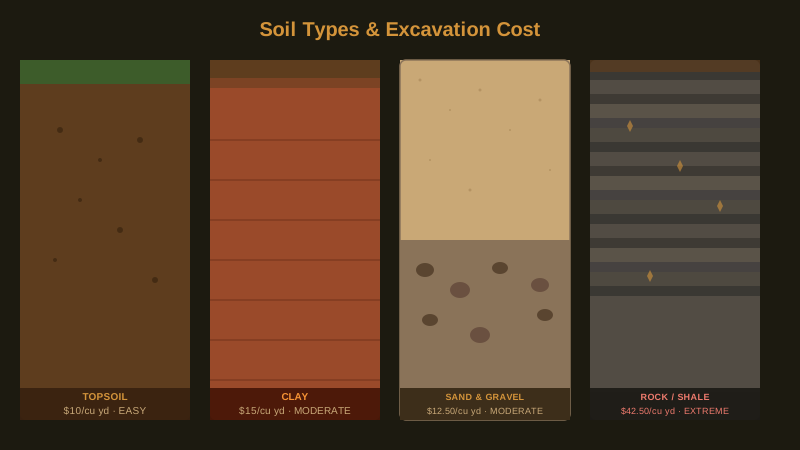
The soil type on your property is the single biggest variable in excavation pricing, often more impactful than project size or depth. A 200 cubic yard job in topsoil can cost less than a 50 cubic yard rock excavation job. Understanding what's in the ground before you start helps you budget accurately and avoid mid-project surprises.
The 4 Soil Types and Their Excavation Costs
1. Topsoil and Loose Fill
Topsoil is the uppermost layer of soil, typically the top 4–12 inches in a natural yard, and deeper in areas that have been previously disturbed and backfilled with loose material. It's the cheapest to excavate because it's already loose, loads fast, and moves easily.
Excavation rate: $8–$12 per cubic yard (RSMeans 2026 baseline)
Characteristics: High organic content, loose structure, low bearing capacity. Topsoil is NOT suitable as structural fill, it compresses and settles under load. Contractors always remove topsoil from building footprints and either stockpile it for landscaping or haul it away.
What to expect: For a project that's primarily in topsoil (say, a grading job on a recently tilled yard or a shallow utility trench), this is the best-case cost scenario. Equipment works at maximum efficiency and the soil dumps cleanly.
Real calculation example: 50×20 ft grading, 2 ft deep (topsoil only)
Volume: (50 × 20 × 2) ÷ 27 = 74.1 cubic yards
Excavation at $10/cu yd × 0.90 (grading) = $667
Hauling at $12/cu yd = $889
Total: $1,556
2. Clay and Compacted Earth
Clay is the most common foundation soil across much of the US Midwest, Southeast, and Gulf Coast. It's cohesive, it sticks together, holds water, and doesn't crumble easily. That's what makes it slow and expensive to excavate.
Excavation rate: $12–$18 per cubic yard
Characteristics: High plasticity, expands when wet, shrinks when dry. Clay soil has reasonable bearing capacity when properly compacted, which is why it's commonly left in place as a building foundation soil in many regions. The USCS (Unified Soil Classification System) classifies clays by plasticity index, high-plasticity clays (CH) are slower and more problematic than low-plasticity clays (CL).
What to expect: An excavator bucket has to work harder to penetrate clay. The soil sticks to the bucket and takes longer to load, and wet clay is dramatically worse than dry clay. Scheduling excavation in dry weather saves real money on clay projects. Wet clay can increase production time by 30–50% compared to dry conditions.
Clay also swells significantly when removed from the ground, typically 25–35% volume increase. This affects hauling calculations: a 100 cubic yard excavation in clay may require 125–135 cubic yards worth of trucking capacity.
Swell factor to use for hauling estimates: 1.30× for typical clay
3. Sand and Gravel
Sandy and gravelly soils are common near riverbanks, coastal areas, glaciated landscapes, and dry climates. They drain well and are easier to excavate than clay, but they have their own challenges.
Excavation rate: $10–$15 per cubic yard
Characteristics: Granular, free-draining, low cohesion. Sandy soil can be excavated quickly, but the walls of an open excavation in pure sand are unstable and can collapse. OSHA regulations require either shoring or sloped walls in sandy soils at depths over 5 feet. The angle of repose for dry sand is about 34 degrees, which means you may need to slope walls significantly, increasing total excavated volume.
What to expect: Below the water table, saturated sand can behave like quicksand, a liquefaction risk that requires dewatering or specialized excavation techniques. If you're excavating near a river, lake, or in a coastal area, ask your contractor about the water table depth and their dewatering plan.
Sand has a low swell factor (about 10–15%) because the granules don't expand the way clay does.
4. Rock and Shale
Rock is the most expensive material to excavate by a significant margin. Hard rock requires specialized equipment, takes more time per cubic yard than any other material, and generates much heavier loads per truck.
Excavation rate: $35–$75+ per cubic yard
Shale: On the lower end ($30–$45/cu yd). Shale is a sedimentary rock that often breaks along natural planes (bedding planes), making it easier to remove than massive rock. A hydraulic breaker attachment on an excavator can often handle it.
Limestone and dolomite: Mid-range ($40–$60/cu yd). Common in the Midwest, Texas Hill Country, and Appalachians. Often removed with a breaker or saw.
Granite, basalt, quartzite: Upper end ($55–$80/cu yd). The hardest common rocks. May require saw cutting or blasting on large volumes.
What to expect: Rock excavation timelines are dramatically longer. A job that takes two days in clay might take two weeks in granite. Plan your project schedule accordingly. Also expect a significant volume increase, blasted rock swells 30–50%, requiring more truck trips than the in-ground volume suggests.
How to Identify Your Soil Type
Site observation
The easiest starting point: look at what's already exposed. Recently disturbed soil in a trench or nearby excavation shows the actual profile. Dark brown or black = topsoil. Brown and sticky = clay. Gray-tan and gritty = sand or sandy loam. Any exposed ledge, large stones coming to the surface, or "ringing" sound when a shovel hits the ground = potential rock.
County soil surveys (NRCS Web Soil Survey)
The USDA Natural Resources Conservation Service publishes online soil maps at websoilsurvey.nrcs.usda.gov. Enter your address, and the map shows the soil series for your property, including estimated depth to bedrock and soil texture. It's free and takes 5 minutes.
Geotechnical test borings
The professional standard. A soils engineer drills 2–4 test holes and logs the soil profile, exactly what's in the ground, at what depth, with density measurements. Cost: $500–$2,000 for a residential site. Recommended before any project where rock or poor soils could significantly change your budget.
Excavator observation
Experienced contractors can often tell what they're into within the first hour of work. A good contractor will call you immediately when conditions change (softer or harder than expected) and present a clear change order process for non-standard conditions.
Using Soil Type in the Calculator
The excavation cost calculator lets you select your soil type (topsoil, clay, sand/gravel, or rock/shale) and applies the appropriate base rate. If you're uncertain, use clay as a conservative middle-ground estimate for most US properties. If rock is a real risk in your area, run both scenarios and note the difference. That's your contingency exposure.
Related Articles
Rock Excavation Cost: Why It Costs 3–4x More
Rock excavation costs $35–$75+ per cubic yard versus $10–$18 for standard soil. Learn what drives the price, how to plan for rock, and what to ask contractors.
Read articleconstructionHow Much Does Excavation Cost in 2026?
Excavation costs range from $1,500 to $15,000+ for residential projects. This breakdown explains what drives the price and how to budget accurately.
Read articleconstructionExcavation Cost Per Cubic Yard: What Contractors Charge
Excavation costs $10–$50+ per cubic yard depending on soil type, project complexity, and hauling. Here is what contractors actually charge and why.
Read article