Rock Excavation Cost: Why It Costs 3–4x More
Rock excavation costs $35–$75+ per cubic yard versus $10–$18 for standard soil. Learn what drives the price, how to plan for rock, and what to ask contractors.
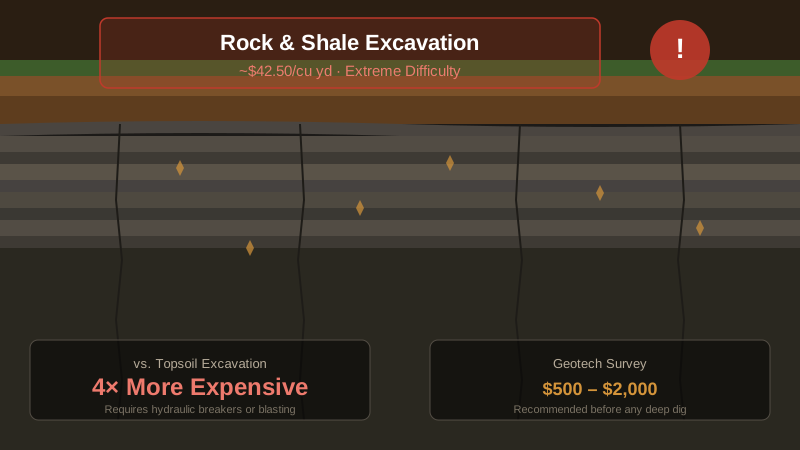
Rock excavation costs $35–$75 per cubic yard for most residential projects, three to four times more than standard clay or topsoil work. When a residential project hits unexpected bedrock, the final bill can easily double. Here's why it costs so much, how to find out if rock is a risk before you start, and how to budget for it intelligently.
Why Rock Excavation Is So Expensive
Standard excavation uses a hydraulic excavator bucket to scoop material from the ground. Rock doesn't scoop. It has to be broken first, which requires specialized equipment and significantly more time.
The three main methods of rock removal, and their typical costs:
Hydraulic rock hammer (breaker)
A hydraulic breaker attachment replaces the bucket on an excavator and hammers the rock repeatedly until it fractures. This method works well for moderate rock (soft shale, weathered granite, limestone). It's slower than digging soil and wears out the attachment.
Typical cost: $35–$50 per cubic yard in-place, plus $500–$1,500 to mobilize the specialized attachment.
Rock saw or cutting wheel
For hard, massive rock formations, a rock saw or cutting wheel cuts the rock into manageable sections for removal. This is slower and more expensive than a hammer but necessary when hammering would cause vibrations that could damage nearby structures.
Typical cost: $50–$80 per cubic yard. More common in urban settings near existing structures.
Blasting
For large volumes of very hard rock (typically on commercial projects or large residential sites in rural areas), controlled blasting is the fastest and cheapest per-yard method. But it requires a licensed blasting contractor, blasting permits, vibration monitoring, insurance riders, and notification to neighbors.
Typical cost: $30–$50 per cubic yard for the blasting itself, plus $2,000–$8,000 in mobilization, permits, and monitoring. Only cost-effective for volumes over 300–500 cubic yards.
Rock Excavation Rate in the Calculator
Our excavation cost calculator uses $42.50 per cubic yard as the base rate for rock and shale, a midpoint between soft shale and harder rock formations, based on RSMeans 2026 data. For your specific situation:
The calculator is a starting point. For projects with confirmed or suspected rock, get a contractor quote that specifically accounts for rock removal.
Sample Calculation: Basement with Rock
Here's a real scenario: 40×30 ft basement excavation, 8 ft deep, confirmed rock at 3 ft depth (so 5 ft of rock to remove, 3 ft of soil above it).
Soil volume: (40 × 30 × 3) ÷ 27 = 133.3 cubic yards at $15/cu yd (clay) × 1.15 = $2,300
Rock volume: (40 × 30 × 5) ÷ 27 = 222.2 cubic yards at $45/cu yd = $10,000
Combined excavation: $12,300, versus about $6,900 if it were all soil.
Add hauling: 355.6 total cu yd × $12/cu yd = $4,267
Total with rock: $16,567 versus $11,167 without rock.
That $5,400 difference is the real cost of hitting rock 3 feet down. Use the rock/shale option in the excavation cost calculator to see the rough cost for a full-rock scenario, then compare that against your all-soil estimate to understand your exposure.
Areas with High Rock Excavation Risk
If you're building in any of these geological zones, rock excavation should be in your contingency budget:
Even in areas known for deep soils, an unusual formation, old quarry fill, or geological anomaly can put rock where you least expect it.
How to Find Out If You Have Rock
Test borings
A geotechnical engineer drills 2–4 test holes to 10–15 feet and logs what's in the ground. Cost: $500–$2,000 for a typical residential site. This is the gold standard for pre-project rock assessment. It also provides a soil bearing capacity report that structural engineers need for foundation design.
Neighbor research
Talk to neighbors who've had recent foundation work, pools, or utility work done. They'll know exactly what they hit and at what depth. Local contractors are another good source, they know the geological patterns in areas where they work regularly.
County soil surveys
The USDA Natural Resources Conservation Service (NRCS) publishes Web Soil Survey maps that include estimated depth to bedrock for most of the US. It's not perfectly accurate for a specific lot, but it identifies risk areas. At websoilsurvey.nrcs.usda.gov you can pull up your property and check the soil series data.
Seismic refraction (for larger projects)
A geophysical method that uses sound waves to detect rock depth without drilling. Useful for larger commercial sites; overkill for most residential projects.
Protecting Yourself in a Contract
If rock is a possibility on your project, get the rock removal rate in writing before work starts. A good contract for rock-risk projects includes:
Contractors who refuse to break out a rock unit price are either assuming you won't hit it (optimistic) or planning to price it at the end when you have less leverage. Neither situation is good for you.
What Happens to Excavated Rock?
Excavated rock is either crushed on-site (if the contractor has a crusher) or hauled to a quarry or recycling facility. Clean rock often has value, crushed rock is used for fill, road base, and drainage aggregate. Some contractors will haul it away for free or even a small credit if they have a nearby use for it. Contaminated rock (near old fuel tanks or industrial sites) is more expensive to dispose of.
Rock typically has minimal swell factor since it's excavated in pieces rather than loose soil. Factor 20–30% for hauling calculations on blasted material.
Related Articles
How Much Does Excavation Cost in 2026?
Excavation costs range from $1,500 to $15,000+ for residential projects. This breakdown explains what drives the price and how to budget accurately.
Read articleconstructionFoundation Excavation Cost: Budget Guide for 2026
Foundation excavation costs $3,500–$12,000 for most homes. This guide breaks down what drives the price for basements, crawl spaces, and slab foundations.
Read articleconstruction4 Soil Types That Affect Excavation Cost (And How Much Each Adds)
Soil type is the single biggest variable in excavation pricing. Topsoil runs $8–$12 per cubic yard while rock hits $35–$75. Here is what each soil type means for your project cost.
Read article