How Much Does Excavation Cost in 2026?
Excavation costs range from $1,500 to $15,000+ for residential projects. This breakdown explains what drives the price and how to budget accurately.
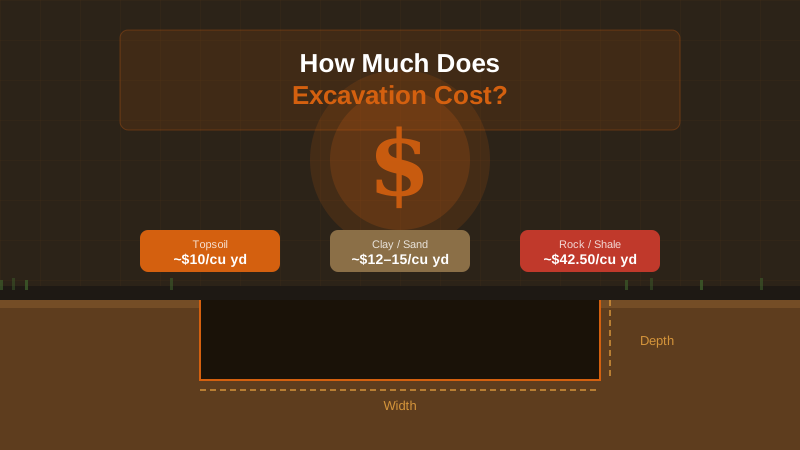
Excavation cost for a typical residential project runs between $1,500 and $15,000, but that range tells you almost nothing useful on its own. A 10×10 trench through loose topsoil and a 50×30 rock excavation for a basement both fall "somewhere in that range," yet one costs 8× more than the other. What you actually need to know is what drives the number, and how to put a real figure on your specific project.
The Short Answer: National Average Costs in 2026
Based on RSMeans 2026 cost data and Angi contractor survey results, here's what residential excavation actually costs:
These are national averages. Expect costs 15–30% higher in the Northeast and West Coast, and 10–20% lower in the rural Midwest and South.
The 4 Biggest Cost Drivers
Soil Type
Soil type is the single biggest variable. Rock excavation costs 3–4× more than topsoil because specialized equipment (hydraulic breakers, blasting rigs, or rock saws) is expensive to mobilize and slow to operate.
Here's what contractors price per cubic yard based on RSMeans data:
If you're excavating in a geologically uncertain area (New England granite country, the Ozarks, parts of the Pacific Northwest), get a geotechnical survey ($500–$2,000) before finalizing your budget. Finding rock mid-project is an expensive surprise.
Project Depth
Every foot deeper costs more. There are two reasons: more material to move, and OSHA safety requirements that kick in at 5 feet. Trenches and excavations deeper than 5 feet require either shoring (temporary wall support) or sloped/benched excavation, both of which add equipment and labor cost. Budget $500–$2,000 extra for OSHA-compliant shoring on deep utility trenches.
Hauling and Disposal
If the excavated material (called "spoil") stays on your property, hauling adds nothing to your bill. The moment a truck leaves the site loaded with dirt, your cost goes up.
Standard clean fill disposal runs $8–$16 per cubic yard. Contaminated soil (anything with petroleum, heavy metals, or chemical contamination) requires licensed disposal and costs $30–$60 per cubic yard. Environmental testing ($300–$500) before digging can tell you if contamination is a risk.
If your site has room, keeping spoil on-site for backfill or grading elsewhere on the property can save $1,000–$4,000 on a medium-sized project.
Site Access
A tight urban lot where a full-size excavator can't maneuver forces contractors to bring in smaller machines or hand-dig sections. Equipment efficiency drops, labor hours go up, and the quote reflects it. If your property has limited access (narrow gates, overhead utility lines close to the dig area, or a shared driveway), mention it upfront and get quotes that account for it.
Project Type Multipliers
Different project types add a complexity factor on top of soil and volume costs:
A Real Cost Calculation Example
Here's how a contractor prices a typical residential foundation excavation job, using the same formula behind our excavation cost calculator:
Project: 40 ft × 30 ft foundation, 4 ft deep, clay soil, standard hauling
Step 1: Volume = (40 × 30 × 4) ÷ 27 = 177.8 cubic yards
Step 2: Excavation cost = 177.8 cu yd × $15/cu yd (clay rate) × 1.15 (foundation multiplier) = $3,072
Step 3: Hauling cost = 177.8 cu yd × $12/cu yd (standard) = $2,133
Total estimated cost: $5,205
Add 10% contingency for unknowns: $5,725
This matches real-world quotes for comparable projects in mid-market areas. Use the excavation cost calculator at the top of this page to run the same calculation for your specific dimensions.
Hidden Costs Most Homeowners Miss
Beyond the excavation itself, budget for these items:
The total hidden cost on a $5,000 excavation project can easily add $1,000–$2,500 if you're not budgeting for them.
How to Get Accurate Quotes
Get at least three contractor bids for any excavation job over $3,000. When comparing quotes, look at:
Walk into those bid conversations knowing the rough cost range. Use the excavation cost calculator to build your baseline, then see how the quotes stack up.
When DIY Makes Sense (and When It Doesn't)
Mini-excavator rentals run $350–$550 per day. For small grading jobs under 50 cubic yards in accessible areas with soft soil, DIY can save significant money. For anything deeper than 4 feet, in rocky soil, near utilities, or requiring OSHA shoring, hire professionals. The liability and safety risk of a wall collapse isn't worth the savings.
For a detailed comparison of costs and risks, see our guide to DIY vs. professional excavation.
Related Articles
Excavation Cost Per Cubic Yard: What Contractors Charge
Excavation costs $10–$50+ per cubic yard depending on soil type, project complexity, and hauling. Here is what contractors actually charge and why.
Read articleconstructionHow to Calculate Excavation Volume in Cubic Yards
To calculate excavation volume: multiply length × width × depth in feet, then divide by 27 to convert to cubic yards. Full guide with examples and common mistakes.
Read articleconstructionFoundation Excavation Cost: Budget Guide for 2026
Foundation excavation costs $3,500–$12,000 for most homes. This guide breaks down what drives the price for basements, crawl spaces, and slab foundations.
Read article