10 Ways to Reduce Excavation Costs Without Cutting Corners
Smart planning can cut excavation costs by 20–40% without compromising safety or quality. Here are 10 practical strategies contractors and homeowners use to keep earthwork budgets in check.
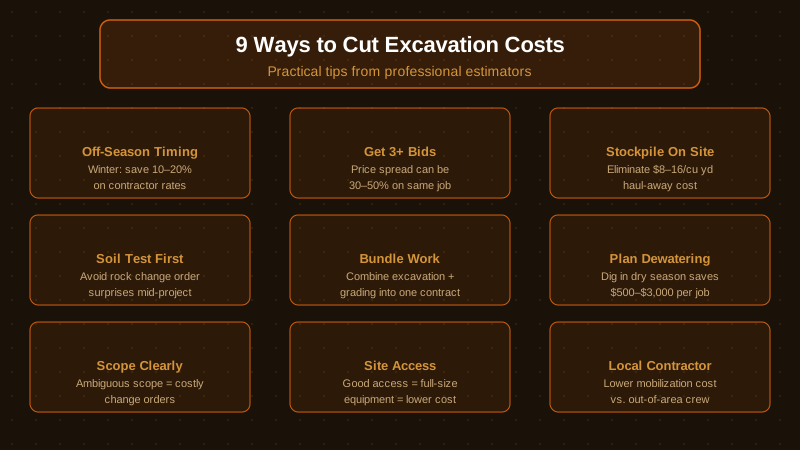
Excavation costs can vary by 30–50% for identical projects depending on timing, access, soil management decisions, and contractor selection. The smart money is in planning, most of the savings come from decisions made before a single bucket of dirt moves. Here are 10 strategies that actually work.
1. Keep Spoil On-Site
Hauling excavated material off-site is often the second-largest cost after the dig itself. Standard hauling runs $8–$16 per cubic yard. On a 200 cubic yard foundation job, that's $1,600–$3,200 in disposal costs.
If your property has a low area that could use fill, a berm you're planning to build, or a garden bed that needs raised topsoil, keeping the spoil on-site eliminates the hauling cost entirely. Talk to your contractor before work starts about stockpile placement. The soil does need to be properly managed (silt fencing around stockpiles in most jurisdictions), but the savings are significant.
Savings potential: $1,000–$4,000 on a medium-sized project
2. Schedule in Dry Season
Wet soil is heavier, stickier, and slower to excavate. A job that takes two days in August might take three days in March because:
In most of the continental US, July through October is the driest window for excavation work. Spring (March–May) is the worst. If your project has flexibility, scheduling in dry months can reduce total cost by 10–20%.
Savings potential: 10–20% of total excavation cost
3. Consolidate Work with Other Contractors
Contractor mobilization (getting equipment to your site) is a fixed cost regardless of project size. A $1,500 mobilization fee on a $3,000 job is a 50% overhead hit. On a $10,000 job, it's 15%.
If you have multiple earthwork needs (foundation excavation, utility trenching, driveway grading, and landscape grading), scheduling them together with one contractor eliminates redundant mobilization charges. Even if work phases need to happen weeks apart, locking in a contractor with a single mobilization can save $1,000–$2,500.
Savings potential: $500–$2,500 in mobilization savings
4. Get at Least Three Bids
This sounds obvious, but a significant number of homeowners get one or two quotes for excavation. The spread between competitive bids is often 20–35% on residential jobs, especially in markets where some contractors have specialty equipment and others use general-purpose machines.
When comparing bids, look at the per-cubic-yard rate (not just the total), what's included or excluded, and the equipment they're planning to use. A contractor using a full-size excavator for a job that could fit one will often be significantly cheaper per cubic yard than one using a mini-ex.
Savings potential: 15–30% versus taking the first quote
5. Offer Site Access That Works for Large Equipment
A full-size excavator (30-ton class) moves material 3–5× faster per hour than a compact machine. If your site can accommodate large equipment, you'll pay a lower effective per-cubic-yard rate even though the hourly rate is higher.
Common access issues:
If any of these apply, get them fixed or planned for before getting quotes. Moving a gate opening costs $500–$1,500. Using large equipment instead of small could save $3,000–$8,000 on a significant project.
Savings potential: 20–40% on equipment cost
6. Know Your Soil Type Before Bidding
When contractors don't know the soil, they bid conservatively, assuming worse conditions than may exist. If you know you have loose sandy soil, topsoil, or light clay, say so in your request for bids. Back it up with a county soil survey or, ideally, a geotechnical report.
The difference between bidding on "unknown soil" and bidding on confirmed clay is often $3–$6 per cubic yard in the base rate, plus the psychological comfort for the contractor to sharpen their pencil. Spending $500–$1,500 on a soil investigation for a project over $5,000 frequently pays for itself many times over.
Savings potential: $3–$6 per cubic yard, or 15–25% for a medium-sized project
7. Consider Cut-and-Fill for Grading Projects
If you need both excavation (removing material) and grading (filling low spots), a cut-and-fill plan balances the two to minimize hauling. A skilled contractor can design a plan where material cut from high spots fills low spots on the same property, eliminating most disposal cost.
This requires a contractor who does topographic site analysis, not just bid-and-dig. It also requires that the fill material is appropriate, some soils (very sandy or organic) aren't suitable for structural fill. But for grading projects with significant elevation changes, a cut-fill analysis can save $1,000–$5,000 in disposal and import fill costs.
Savings potential: $1,000–$5,000 on grading-heavy projects
8. Offer Free Fill to the Contractor
Some excavated fill has value, sandy loam, gravel, or even topsoil is useful to contractors doing other projects in the area. If you offer the contractor the ability to take your fill for their own use (rather than paying to dispose of it), they may either haul it away for free or offer a credit on the job.
This doesn't always work (the timing has to align with their other projects) but it costs nothing to ask. In areas with active construction, clean fill is in demand.
Savings potential: $500–$2,000 in hauling credits or waived disposal fees
9. Phase Your Project to Avoid Double Mobilization
If you're building a home addition and also need a new utility line run, plan to do the utility trench before the foundation excavation, not after. Combining them into one site visit from the excavation contractor eliminates a second mobilization charge.
Similarly, if you have landscaping grading to do after construction, schedule it as part of the contractor's final site visit to grade away from the foundation, not as a separate engagement weeks later.
Good project sequencing saves mobilization costs at every phase. Think about what earthwork tasks you have over the next 6–12 months and whether any can be consolidated.
Savings potential: $500–$2,000 per avoided mobilization
10. Use the Calculator to Catch Scope Errors Before Breaking Ground
Contractors occasionally make calculation errors in volume estimation, either over or under. An estimate that's 20% too high means you're paying for work you shouldn't be. An estimate that's 20% too low means a change order later when the contractor runs long.
Use the excavation cost calculator to check the volume in cubic yards before your contractor starts. Compare their estimated volume to yours. A 10–15% discrepancy is normal (different assumptions about slope and working clearance). A 30%+ discrepancy warrants a direct conversation before work begins.
You're not checking up on your contractor; you're aligning expectations before money changes hands. Most experienced contractors respect a client who knows the numbers.
Savings potential: Avoiding 10–25% in overcharges or preventing costly change orders
Putting It Together
The biggest savings come from the first few items on this list: keeping spoil on-site, scheduling in dry season, and getting competitive bids. Together, those three moves can realistically cut 25–40% off the cost of a medium-sized excavation project without compromising safety, quality, or compliance.
Use the excavation cost calculator to establish your baseline before the first contractor call. Walking in with a real number (even a rough one) changes the tone of the bidding conversation and helps you spot outliers on both ends.
Related Articles
How Much Does Excavation Cost in 2026?
Excavation costs range from $1,500 to $15,000+ for residential projects. This breakdown explains what drives the price and how to budget accurately.
Read articleconstructionDIY vs. Professional Excavation: When Each Makes Sense
DIY excavation with a rented mini-excavator costs $350–$600 per day. Professional contractors charge $10–$50+ per cubic yard. Here is how to decide which is right for your project.
Read articleconstructionExcavation vs. Grading: Key Differences and When You Need Each
Excavation removes soil from a specific area; grading reshapes the ground surface. Both move dirt, but the equipment, cost, and purpose are different. Here is how to tell which you need.
Read article