When to Hire an Excavation Contractor: Red Flags and Green Lights
Knowing when to hire a professional excavation contractor (and how to choose the right one) can save thousands and prevent costly mistakes. Here is what to look for.
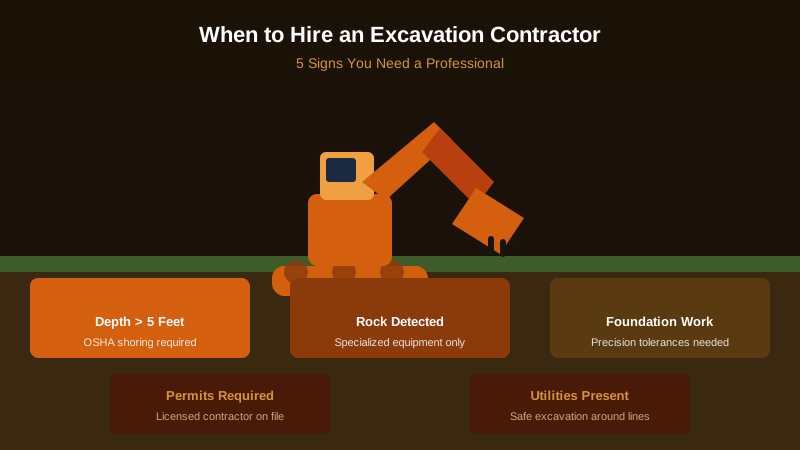
Choosing the right excavation contractor isn't just about getting the lowest price. The right contractor finishes on time, stays within budget, handles surprises professionally, and leaves your site in the condition they said they would. The wrong contractor drags the job out, produces unexpected change orders, and may cut corners on safety compliance. Here's how to tell the difference.
When You Definitely Need a Professional Contractor
Some projects leave no room for DIY:
Any excavation over 5 feet deep
OSHA regulations require engineered protective systems for excavations deeper than 5 feet where workers will enter. Professional contractors understand these requirements and carry the equipment (shoring, trench boxes) to comply. This is one area where non-compliance can result in fines and (more seriously) in fatalities.
Foundation and basement work
The dimensional tolerance on foundation excavation is tight, typically ±2–3 inches. Over-excavating damages the bearing soil and requires expensive remediation. Under-excavating means hand-chipping or blasting at higher cost. Foundation work is professional territory.
Rock conditions
Hydraulic breakers, rock saws, and blasting equipment aren't available at consumer rental yards for good reason. Rock excavation requires specific equipment, training, and experience to do safely and efficiently. If you have rock, you have a professional project.
Near utility lines or existing structures
Working within 10 feet of underground utilities, an existing foundation, or a neighboring property line requires the experience and care that comes from doing it professionally many times. Hitting a gas line or undermining a neighbor's foundation creates liability that far exceeds any savings from DIY.
Projects with firm construction timelines
A contractor with dedicated equipment and a crew can complete most residential excavation in 1–3 days. DIY on weekends adds weeks to your schedule and leaves an open excavation exposed to weather, safety risks, and building permit time constraints.
Green Lights: Signs You Have a Good Contractor
They visit the site before quoting
A contractor who quotes via email without seeing your property is estimating blind. Any competent contractor bidding an excavation job should walk the site, assess soil conditions, equipment access, utility marking, and distance to spoil disposal before giving a number.
They ask about your soil type and water table
These are the two biggest cost drivers. A contractor who asks intelligent questions about what's in the ground and how close the water table is will give you a more accurate quote and fewer surprises.
Their volume estimate is close to yours
Before your first contractor meeting, run your project through the excavation cost calculator and note the cubic yard estimate. A contractor whose volume estimate differs from yours by more than 20–25% should be able to explain why. Sometimes it's legitimate (they're accounting for slope clearance, you forgot the working width). Sometimes it's a scope error.
They have a clear process for encountering rock
Rock is the biggest unknown in any excavation project. A good contractor addresses it upfront: "If we hit rock, we'll call you immediately, take measurements and photos, and price any additional rock removal at $X/cu yd before proceeding." A vague answer here means uncertainty for you when the unexpected happens.
They pull permits themselves
Any contractor doing foundation excavation should pull the associated permits. If they're asking you to pull permits for their work, or suggesting permits aren't required when they should be, that's a compliance red flag.
They carry liability insurance and worker's comp
Ask for certificates of insurance before signing anything. Liability insurance (minimum $1M for residential work) covers damage to your property or adjacent properties during work. Worker's compensation covers their employees if injured on your site. Without it, an injured worker could sue you directly.
Red Flags: Signs to Walk Away
No written contract or scope
A handshake deal or email quote isn't a contract. Any excavation job over $1,000 should have a written scope of work that defines what's included, what's excluded, how surprises are handled, and payment terms.
Unusually low bid
If one contractor quotes $3,500 and everyone else quotes $6,000–$7,500, the low bidder is either underestimating the work or planning to make up the difference with change orders. Ask them to explain their volume estimate and unit price per cubic yard.
Aggressive upfront payment requests
Standard in the industry is a deposit of 10–25% to schedule work, with remaining payments tied to milestones. A contractor who demands 50%+ upfront is a risk.
Vague change order terms
"We'll work it out if we hit anything unexpected" is not an acceptable change order policy. Before work starts, you want a written unit price for rock removal, an agreed process for documenting changed conditions, and a definition of what triggers a change order versus what's included in base scope.
No 811 call before starting
Any professional contractor performing excavation will call 811 or document that utilities were already marked before starting work. If your contractor begins digging without this step, stop the work immediately.
Cash-only payment
Legitimate contractors accept checks and often credit cards. Cash-only payment (especially with no receipt) suggests someone who won't be around if there's a problem later.
How to Compare Contractor Bids
When you have 3+ quotes:
A contractor who is 15% more expensive but has stellar references for handling surprises professionally may be a better choice than the lowest bidder.
Setting Up Your Project for Success
Before your contractor starts:
The cheapest contractor on paper is rarely the cheapest in practice. Build a rough baseline in our calculator first (it takes about a minute), then use that number as the anchor in every conversation. Bids inside ±15–20% of it are fair game; bids that sit noticeably above or below are the ones where you ask the questions in the checklist above and see how the contractor answers.
Related Articles
How Much Does Excavation Cost in 2026?
Excavation costs range from $1,500 to $15,000+ for residential projects. This breakdown explains what drives the price and how to budget accurately.
Read articleconstructionDIY vs. Professional Excavation: When Each Makes Sense
DIY excavation with a rented mini-excavator costs $350–$600 per day. Professional contractors charge $10–$50+ per cubic yard. Here is how to decide which is right for your project.
Read articleconstructionExcavation Permits and OSHA Regulations: What You Need to Know
Most excavations over 5 feet deep require OSHA-compliant protection systems. Permits vary by municipality. This guide covers what approvals you need before digging starts.
Read article